Dog Enrichment Ideas: 15 Ways to Beat Boredom at Home
- Why enrichment matters more than another walk
- Signs your dog could use more enrichment
- Sniff-based enrichment (often the highest value-per-minute)
- Food puzzles and slow feeding
- DIY brain games
- Training and structured play
- Digging, chewing, and self-directed play
- Matching activities to your day
- Building a simple rotation
- The bottom line
Why enrichment matters more than another walk
A tired dog isn't always a satisfied dog. Physical exercise burns energy, but it's mental and sensory engagement — sniffing, problem-solving, foraging, choosing — that actually settles a restless brain. Dogs bred for jobs (herding, retrieving, scent work) and high-energy adolescents are the ones who suffer most when their day is just meals, a walk, and a lot of waiting around. The good news: enrichment doesn't require a yard, a pile of equipment, or a trip to a pet store. Most of what follows uses things you already own.
Below are 15 enrichment ideas grouped into five categories, so you can match the activity to your dog's energy level, chewing habits, and how much supervision you can realistically give. A few use gear worth understanding first — if you're building out a toy rotation, our guide to safe dog toys by size and material is a useful companion read.
Signs your dog could use more enrichment
Boredom shows up differently in different dogs, so it helps to know what you're looking for before you start troubleshooting. Common signals include chewing on things that aren't toys, pacing or restlessness in the evening, barking at nothing in particular, digging where they shouldn't, or a sudden burst of "zoomies" right after you sit down. None of these are dramatic on their own, but a pattern of them — especially paired with a dog who gets plenty of physical exercise but still seems unsettled — usually points to unmet mental stimulation rather than a training problem to correct.
Sniff-based enrichment (often the highest value-per-minute)
A dog's nose does more real cognitive work than almost anything else you can offer, and many trainers find that a scent game leaves a dog more settled than a lap around the block — though direct comparisons between sniffing and walking haven't been well studied, so treat it as a widely shared observation rather than a measured fact.
1. Snuffle mat foraging. Scatter kibble or small treats through the fabric strips of a snuffle mat and let your dog root them out. Ten minutes of committed sniffing is often described as roughly equivalent, in mental fatigue, to a much longer walk. Check the mat periodically and retire it if your dog starts pulling the strips loose rather than sniffing through them.
2. Scatter feeding in grass or on a towel. Skip the mat entirely — toss a meal's worth of kibble across a lawn, a folded towel, or a low-pile rug. Cheap, mess-contained, and effective.
3. Hide-and-seek treats. Start with treats in plain sight, then progress to easy hiding spots (under a cushion, behind a chair leg) as your dog learns the game. This also reinforces a reliable "find it" cue you can use anywhere.
4. Cardboard box scent search. Line up a few open boxes, hide a treat or a favorite chew in one, and let your dog work through the row. Supervise closely if your dog tends to shred cardboard rather than just sniff it — ingested cardboard can cause digestive upset.
5. Decompression sniff walks. Not a training walk — a walk where your dog sets the pace and stops to investigate whatever it wants, on a longer line if your leash setup allows it. Fifteen unhurried minutes of sniffing can be more mentally tiring than thirty minutes of brisk, structured walking.
Worth knowing: scent games are low-impact physically, which makes them a good option for seniors, recovering dogs, or anyone told by a vet to limit activity — but confirm that guidance with your vet if your dog has a specific injury or condition.
Food puzzles and slow feeding
Turning mealtime into a small challenge is one of the easiest enrichment wins because you're not adding calories — you're just changing how existing food gets delivered.
6. Frozen lick mat. Spread a thin layer of plain unsweetened yogurt, plain canned pumpkin purée (not pumpkin pie filling, which adds sugar and spices), or your dog's usual wet food across a textured lick mat and freeze it. Some dogs don't handle dairy well, so start with a small amount of yogurt — or skip it entirely — if your dog has a sensitive stomach. The licking motion itself has a calming effect for many dogs, which makes this a good pre-departure or post-walk activity.
7. Stuffed and frozen chew toy. Pack a hollow rubber toy with a mix of kibble and something sticky, then freeze it. If you reach for peanut butter, read the label first and confirm it doesn't contain xylitol (also sold as birch sugar), which is toxic to dogs. Freezing extends how long the activity takes, which is the whole point — a toy your dog empties in ninety seconds isn't doing much.
8. Slow feeder bowls or interactive feeders. For dogs who inhale their food, a slow feeder or puzzle feeder turns each meal into a short problem-solving session and can reduce the gulping that leads to regurgitation in some dogs. We compare styles and materials in our slow feeder bowl guide.
Worth knowing: any frozen or stuffed food toy should be sized appropriately — a toy small enough to lodge in the mouth or throat is a real hazard, so size up rather than down, and supervise until you know how your dog handles a given toy.
DIY brain games
You don't need a purpose-built puzzle toy to make your dog think — a lot of effective enrichment comes from household objects used differently.
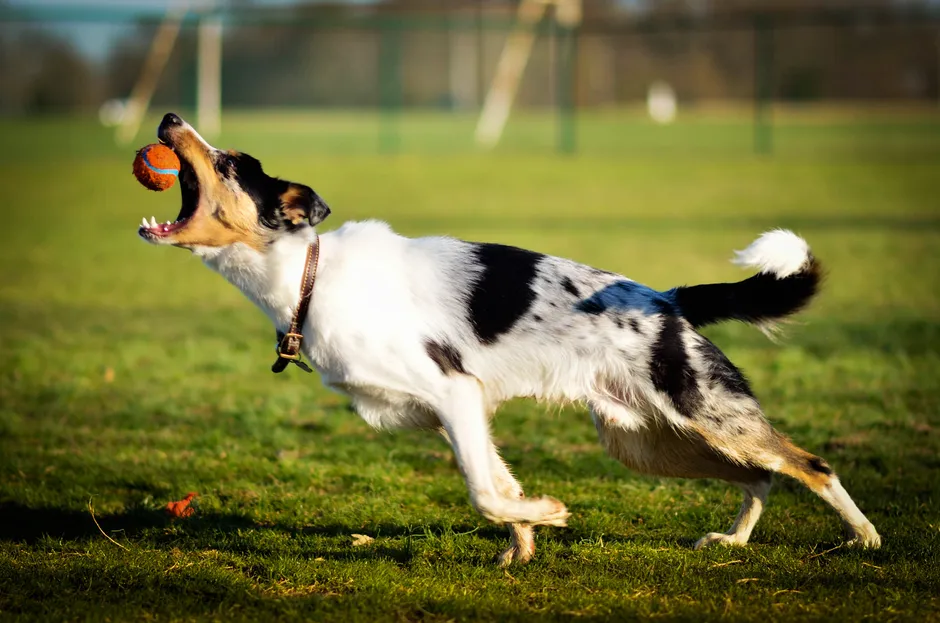
9. Muffin tin puzzle. Drop treats into several cups of a muffin tin and cover each with a ball. Your dog has to move the balls to get the reward — simple, cheap, and engaging for a lot of dogs. Size the balls to your dog rather than to the tin: a standard tennis ball is a documented choking hazard for large and giant breeds, because it can compress and lodge at the back of the throat, and tennis-ball felt is abrasive enough to wear down enamel with repeated chewing. Pick a ball that clearly can't fit past your dog's back teeth, size up when you're unsure, stay in the room while the game is running, and put the balls away afterward. For small dogs, a jumbo tin with correspondingly larger balls works better than a mini tin with small ones.
10. Towel roll-up. Scatter treats along a towel, then roll it up loosely. Unrolling it to find the treats is a satisfying low-effort puzzle, especially for dogs new to food games. Take the towel away once the treats are gone — a shredded towel is easy to swallow.
11. "Which cup" game. Place a treat under one of three cups, shuffle them slowly, and let your dog choose. Use sturdy cups too big to fit in your dog's mouth, and swap to a different game if your dog's strategy turns into chewing the cup rather than nosing it aside. This borrows from classic shell games and works well as a short indoor session on a rainy day.
Worth knowing: every idea in this section puts loose, shreddable objects in front of your dog — balls, towels, cups — so treat these as supervised, put-away-afterward games rather than something you leave down. Size any ball or cup so it can't fit fully into your dog's mouth, and end the session the moment your dog shifts from solving the puzzle to dismantling it. It also helps to rotate which puzzles are out rather than leaving everything available at once. Novelty is a big part of why enrichment works — a puzzle your dog has mastered and sees daily stops being much of a puzzle at all.
Training and structured play
Training sessions are enrichment in disguise, and they build the relationship and impulse control that make the rest of daily life easier.
12. Five-minute trick training. Short, frequent sessions (think five minutes, several times a day) beat one long session for most dogs. Teaching a new trick — spin, paw target, "go to mat" — is genuinely tiring in a good way.
13. Structured tug. Tug with clear start and stop cues ("take it," "drop it") is both physical exercise and impulse-control training, not just a wrestling match. It's a good outlet for dogs with strong prey drive or high arousal. Use a long tug toy so hands stay well away from teeth, and inspect it for tears before each session.
14. Indoor obstacle course. Couch cushions to jump over, a broom laid across two boxes to step over, a hallway weave through kitchen chairs — a five-minute obstacle course built from furniture gives high-energy dogs a physical and mental outlet on days when weather keeps you inside.
Digging, chewing, and self-directed play
Some enrichment is about giving a dog a legal outlet for a behavior they're going to do anyway.
15. A designated digging spot. For dogs who dig, a sandbox or a section of yard where digging is allowed (and rewarded, at least at first) redirects the instinct instead of fighting it. Bury a few toys to make it worth returning to.
For dogs whose favorite pastime is destroying things, appropriate chews matter as much as puzzle toys — our puzzle toy roundup breaks down difficulty levels if you're trying to match a toy to a genuinely determined dog. No chew or toy is fully indestructible, and any product marketed that way should be treated skeptically — supervise new chews until you know how your dog handles them.
Matching activities to your day
| Activity type | Time needed | Supervision level | Best for |
|---|---|---|---|
| Snuffle mat / scatter feeding | 5–15 min | Low, but check the mat for pulled-loose strips | Any dog, especially high-sniff breeds; fine for casual chewers |
| Decompression sniff walk | 15–30 min | Medium — you're on the other end of the line | Restless dogs, seniors, low-impact days |
| Frozen lick mat or stuffed toy | 15–40 min | Low once frozen — but only after you've watched how your dog handles that specific toy | Anxious dogs, alone-time prep; size up for determined chewers |
| Muffin tin / towel puzzles | 5–10 min | Medium — loose balls and fabric get shredded | Food-motivated dogs, rainy days; skip if your dog swallows what it destroys |
| "Which cup" game | 5 min | Medium — cups are chewable, so stay in the room | Dogs who like thinking games; not for dedicated cup-crushers |
| Trick training | 5 min, several times daily | High (active engagement) | Any dog, great for puppies; nothing chewable involved |
| Structured tug | 5–10 min | High — you're holding one end | High-arousal dogs and strong chewers who need a legal outlet |
| Indoor obstacle course | 10–15 min | High | High-energy dogs, bad-weather days |
| Digging box | Ongoing | Medium | Known diggers with yard access |
Building a simple rotation
You don't need all 15 ideas running at once. A realistic rotation might look like: one sniff-based activity daily, one food puzzle at a meal, and one training or structured-play session — swapped out every week or two so nothing goes stale. Watch your dog's reaction rather than assuming: a dog who ignores a snuffle mat but goes wild for a shuffled-cup game is telling you something about what motivates them.
It also helps to think in terms of a time budget rather than a checklist. Most households don't have time for all five categories every day, and that's fine — a nose-work game most mornings plus a frozen food toy on days you leave the house covers a lot of ground on its own. Puppies generally do better with more frequent, shorter sessions since their attention span is short; adult dogs can usually handle a longer single session. Senior dogs often do best with sniff-based and lick-based activities that provide mental engagement without much physical strain, though any exercise plan for a senior or dog with joint issues is worth running by your vet first.
If your dog has recently developed sudden anxiety, destructive behavior, or a loss of interest in things they used to enjoy, that's worth a conversation with your vet before you troubleshoot with more toys — behavior changes sometimes have a medical root.
The bottom line
Enrichment isn't a single product — it's a pattern of small, varied challenges spread across the day. Rotating a handful of low-cost activities, sized and supervised appropriately, does more for a bored or anxious dog than any single toy ever will. Start with two or three ideas from this list, watch what your dog actually engages with, and build from there.